
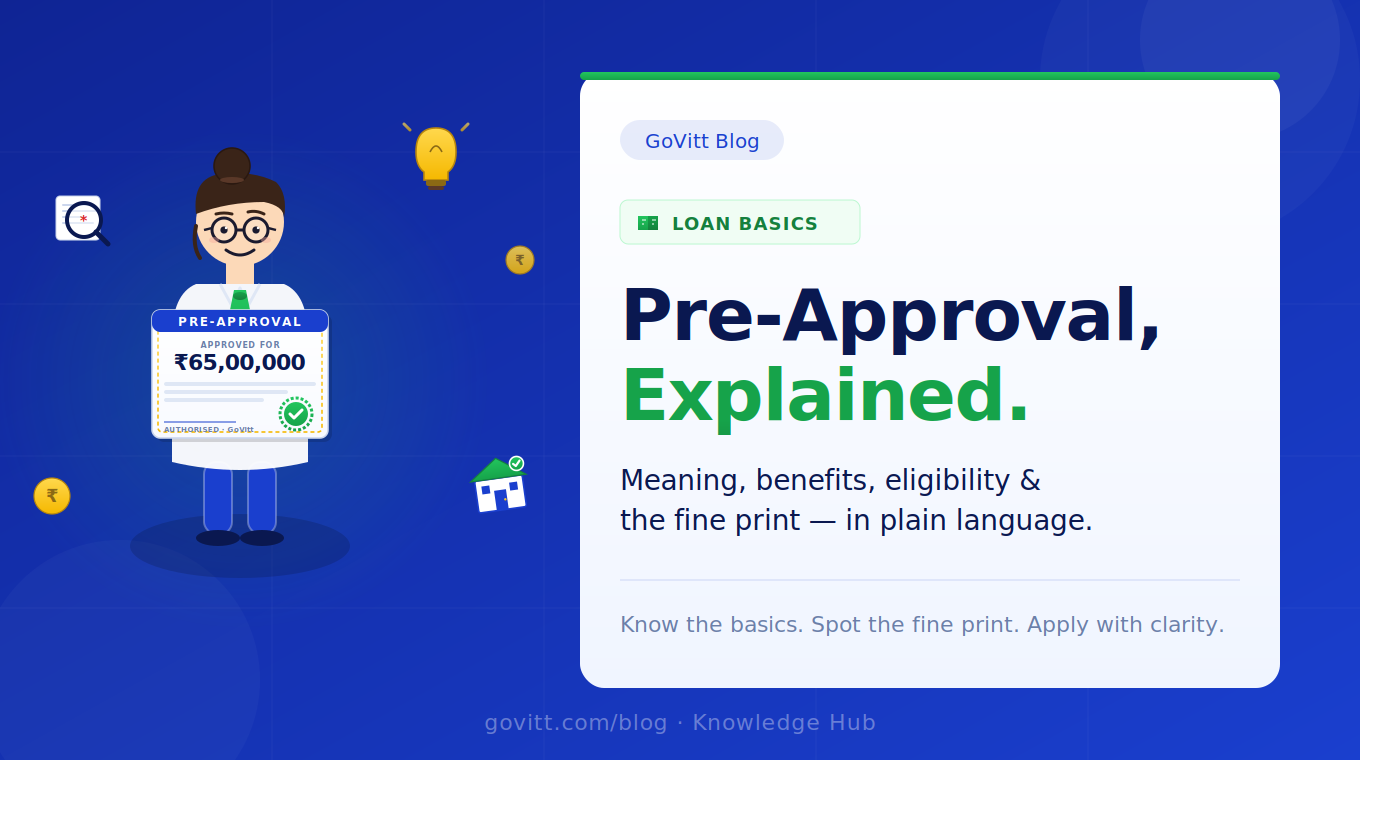
If you have a salary account at any PSU Bank (like SBI & UCO) or private bank (HDFC Bank & ICICI Bank etc), you've probably seen one of these messages drop into your inbox:
"Congratulations! You're eligible for a pre-approved home loan up to ₹50 lakh"
Or maybe a banner on your mobile banking app: "Instant home loan offer — minimum documentation, quick approval."
Tempting, right? Especially if you're already thinking about buying a place. Feels like the bank's done half the work for you.
Here's the part nobody seems to mention clearly: a pre-approved home loan is not an approved home loan. It's not a sanction. It's not a guarantee. It's something in between a marketing offer and a polite suggestion that you'd probably qualify if you applied.
That doesn't make it useless — far from it. A genuine pre-approval can speed things up, give you real clarity on your budget, and put you in a stronger position when you're negotiating with sellers. But treating it as money-in-the-bank is one of the more common mistakes first-time buyers make, and it can lead to some painful surprises later.
This guide walks you through what a pre-approved home loan actually is, what it's worth, who tends to get them, and the fine print that gets glossed over in those cheerful WhatsApp messages.
So what does "pre-approved" actually mean?
A pre-approved home loan is a conditional offer. The bank has looked at your financial profile from the outside — usually because you already bank with them — and made an early call that you'd probably qualify for a certain loan amount.
To make that call, they're typically looking at:
- Your income (especially what's hitting your salary account every month)
- Your repayment behaviour on existing loans and credit cards
- Your CIBIL score
- Your CIBIL score
- How long you've been a customer with them
- Any current EMIs you're already servicing
From that, they put together a number — "You can probably get up to ₹X at roughly Y% over Z years."
A quick example. Salaried, ₹1 lakh a month, score above 750, decent banking history, no other big EMIs. Your bank might ping you with a pre-approved offer for ₹60 lakh.
Sounds great. But here's the thing: that ₹60 lakh isn't sitting somewhere with your name on it. The bank is essentially saying based on what we know about you so far, we'd probably lend you this much, on a clean property, after we verify everything properly.
That word "probably" is doing a lot of work in that sentence.
How the process actually plays out
It usually goes through four stages.
Stage 1: The bank quietly looks at you
This part happens without you doing anything. The bank pulls together what they already know — salary credits, account transactions, your credit report, existing liabilities, repayment patterns. Existing customers get pre-approved offers faster simply because the bank already has all the data; they don't need you to fill out forms to get a sense of you.
Stage 2: The offer lands
You get an SMS, an email, a banner on your banking app, sometimes a phone call from a relationship manager. The offer typically tells you:
- An estimated loan amount
- A tentative interest rate
- A possible EMI range
- A validity period (usually 30 to 90 days)
This is the moment most people get excited. Resist that urge for now — read the fine print first.
Stage 3: You actually pick a property
This is where things get real. Once you've shortlisted a property, the bank goes into proper diligence mode:
- Legal verification — checking the title chain, encumbrance certificate, all the property paperwork
- Technical valuation — sending a valuer to see if the property is actually worth what the seller is asking
- Builder/project checks — for under-construction or new builds, the project itself needs to be on the bank's approved list
- Updated financial review — they look at your situation again, in case anything has changed
This is also the stage where the dream sometimes meets reality. The valuer might come back with a number lower than the agreement value. The builder might not be on the bank's list. The title might have an issue you didn't know about.
Stage 4: Final sanction (if everything checks out)
Only after all of the above does the bank actually sanction the loan and disburse the money. This is real approval. Everything before this is just an indication.
Who actually gets these offers?
Not everyone. Banks are picky about who they send pre-approved loans to, because they're essentially using their own risk models to decide who they're confident about up front.
Common profiles that tend to receive offers:
Salaried employees with stable jobs
If your salary lands in the same account every month, on the same date, from a recognisable employer — you're an easy bet. Some employer profiles tend to get more attention:
- IT and tech professionals at large firms
- Government and PSU employees
- MNC employees in well-known companies
- Employees of listed corporates
Stability matters more than the size of the paycheque, honestly. A government employee earning ₹70,000 might get a more attractive offer than a startup employee earning ₹1.2 lakh whose salary varies by month.
Existing bank customers
Banks know their own customers better than anyone else, so they pre-approve their own first. If you've had a salary account at the same bank for a few years, with no bounced cheques or missed credit card payments, expect them to come knocking eventually.
People with strong credit profiles
The unspoken bar is usually a CIBIL score of 700 or higher, low credit card utilisation, and a clean repayment history. The cleaner your profile, the more attractive the offer terms.
The unspoken bar is usually a CIBIL score of 700 or higher, low credit card utilisation, and a clean repayment history. The cleaner your profile, the more attractive the offer terms.
That said, eligibility rules vary lender to lender. Some banks are stricter, some are more aggressive about acquiring new home loan customers, and that shows up in who they pre-approve.
What's the actual benefit, then?
If pre-approval doesn't guarantee anything, why bother engaging with it? A few real reasons.
You move faster
Property markets in active cities don't wait. If you find a flat you like, you usually have days, not weeks, to lock it in. A pre-approved buyer can move much faster than someone starting from scratch — a lot of the financial diligence is already done, so the bank's focus shifts almost entirely to the property side.
You actually know your budget
This one's underrated. A lot of buyers go house hunting based on a vague sense of what they can afford and end up either falling in love with something out of reach or low-balling themselves. A pre-approved number gives you a real, lender-validated ceiling. I can borrow up to ₹45 lakh, which means I can look at properties up to roughly ₹55–60 lakh with my own contribution. That clarity changes how you shop.
You look serious to sellers and builders
Sellers — especially in resale — pay attention to financial readiness. A buyer with a pre-approval letter looks more credible than one who's "still arranging finance." Some builders also handle pre-approved customers differently, sometimes offering pricing flexibility because the deal is more likely to actually close.
Smoother overall experience
Less paperwork the second time around, less hand-holding required, less back-and-forth. For a process that can already feel like a part-time job, every bit of friction removed helps.
If you'd rather see what offers you'd qualify for across multiple lenders before committing — instead of just taking your existing bank's word for it — platforms like GoVitt let you compare home loan options across many lenders in one place. This way you're not just accepting whatever your salary bank offers; you're seeing where the best deal actually sits for your profile.
So does pre-approval guarantee approval?
No. And this is where things get awkward when buyers don't read the fine print.
A pre-approved offer can absolutely fall apart at the final approval stage. Here are the situations where it commonly does:
- The property has legal issues the bank's lawyers don't like
- The valuer values the property lower than what you're paying, so the bank reduces the loan amount
- Your credit score has dropped between when the offer was made and when you actually applied
- You took on new debt in the meantime — a personal loan, a big credit card balance, a car loan
- Your job situation changed — resignation, probation at a new employer, a notice period
- A document doesn't match what the bank expected from their initial assessment
Real example of how this plays out. Buyer gets a ₹50 lakh pre-approval. Goes shopping confidently. Finds a flat at ₹60 lakh, pays a token amount. Bank's valuer comes back and values the property at ₹52 lakh. The bank will only fund 80% of the valuation (not the agreement value), so the actual loan offered drops to around ₹42 lakh. Now the buyer has to bring an extra ₹8 lakh out of pocket — money they hadn't planned for.
This isn't rare. It happens enough that you should plan for it as a real possibility, not a worst case.
The fine print most people don't read
The offer expires
Most pre-approvals are valid for 30, 60, or 90 days. If you don't act within that window, the bank will need to reassess your situation. Your salary, score, and liabilities can all have shifted by then, and the new offer might not look like the old one.
The advertised rate isn't necessarily what you'll pay
That "starting from 7.2%" is a starting point. Your actual rate at the time of disbursement depends on your updated credit score, the loan amount, the property type, and what's happening with the repo rate. If rates have moved up between offer and disbursement, your rate moves with them.
The amount can shrink
The final sanction amount can be lower than the pre-approved amount, for any of the reasons mentioned above. Don't make property commitments you can't fund if the loan ends up smaller.
You'll still submit documents
Pre-approval doesn't mean zero paperwork. The bank will still ask for current salary slips, recent bank statements, ITRs, KYC, and the full property file. Some borrowers expect a near-paperless experience and are surprised when they're asked for the same documents as everyone else.
The fees aren't always discounted
People sometimes assume pre-approved loans come with lower processing fees. Some lenders do discount; many don't. Always ask for the full fee structure in writing — processing fee, legal verification charges, technical valuation charges, any insurance bundled with the loan.
Pre-approved vs final approval — at a glance
What's been done
| Pre-Approved Loan | Final Approval |
|---|---|
| Financial profile checked | Yes |
| Yes (again) | Property verification done |
| No | Yes |
| Loan amount locked | Tentative |
| Final | Money ready to disburse |
| No | Yes |
| Actual guarantee of disbursement | No |
| Yes (post-sanction) | The key thing this table tries to show: pre-approval is about you. Final approval is about you and the property and current conditions, all together. They're meaningfully different things. |
Should you accept the offer?
Depends on your situation, honestly.
It's worth taking seriously if:
- You're actively house hunting and need to move quickly
- You want a clear sense of what you can afford
- Your finances are stable and you don't expect that to change in the near term
- The terms (rate, fees, tenure) actually look competitive when compared to other lenders
Pause before accepting if:
- The bank is pushing you to commit quickly without giving you time to compare
- The fee structure isn't transparent
- The interest rate is being framed as "starting from" without telling you what your actual rate will be
- You haven't bothered to check what other lenders would offer
Never accept a pre-approved offer purely because it's pre-approved. The "pre-approved" label is a marketing convenience for the bank, not a sign that the offer is the best one available to you. Always check rates, fees, tenure flexibility, and prepayment terms across at least two or three lenders before signing anything.
How to make sure your pre-approval actually converts
This part matters. A pre-approval can lapse for things you control — so don't shoot yourself in the foot during the property hunt.
Don't mess with your credit score
Between the offer and the final sanction, behave as if the bank is watching. Pay every credit card bill on time. Pay every existing EMI on time. Don't max out cards. Even one missed payment in this window can drag your score and undo the offer.
Don't take on new debt
This is the big one. People sometimes take a personal loan to fund the down payment, or buy a car right before the home loan disburses, or take a big amount on credit cards. Every new EMI reduces your eligibility. The bank reassesses at sanction stage, and if your debt-to-income ratio has worsened, your home loan can shrink or disappear.
If you absolutely need additional funds for the down payment, talk to the bank or a comparison platform first — there are usually cleaner ways than tacking on a personal loan.
If you absolutely need additional funds for the down payment, talk to the bank or a comparison platform first — there are usually cleaner ways than tacking on a personal loan.
Keep your documents current
Salary slips, bank statements, ITR, KYC — make sure all of it is updated and consistent. Mismatched information is a common reason for last-minute hiccups.
Pick a clean property
This isn't always in your control, but to the extent it is — go for properties with clear legal documentation, RERA registration where applicable, and ideally builders the bank already approves. A messy property can torpedo even the cleanest pre-approval.
Key takeaways
- Pre-approval is a conditional indication, not an actual sanction
- The bank still has to verify the property and re-check your finances before final approval
- It's most useful for moving fast, knowing your budget, and looking serious to sellers
- Existing bank customers and salaried borrowers with strong credit get most of these offers
- The amount, rate, and terms can all change between offer and disbursement
- Compare across lenders before accepting — pre-approved doesn't mean best-priced
- Don't take on new debt or skip payments while you're between offer and sanction
Conclusion
A pre-approved home loan is a useful tool when you understand what it actually is — and a misleading one when you don't.
Used well, it gives you clarity, speed, and a credible position when you're negotiating for property. Used badly — accepted blindly without comparing, or treated as a guarantee that no longer requires care — it can leave you scrambling when reality intrudes at the final sanction stage.
The smart move is to take the offer seriously, but not exclusively. Treat it as one option, not the only one. Compare it against what you'd qualify for at other lenders, look closely at the all-in cost (rate plus fees plus charges), and make sure the property you eventually pick is the kind banks are comfortable financing.
If comparing lenders manually feels like work, platforms like GoVitt are built for this — you can see eligibility, rates, and terms across many lenders without making a dozen separate enquiries. The point is just to make sure your final decision is informed, not convenient.
A few hours of comparison now is worth lakhs over the next twenty years.
A few hours of comparison now is worth lakhs over the next twenty years.
FAQs
Can I apply for a pre-approved home loan before I've found a property?
Yes — in fact that's usually the whole point. Pre-approval happens before you choose a property, so you know your budget when you start hunting. You'll still need to come back to the bank with the property details once you've found something.
Do pre-approved offers only come from your existing bank?
Mostly, yes. Your existing bank already has all your financial data, so they're the natural source. But other lenders sometimes pre-approve people too — through credit bureaus, partnerships with employers, or comparison platforms that match you to lenders based on your profile. So don't assume your existing bank is the only option.
Mostly, yes. Your existing bank already has all your financial data, so they're the natural source. But other lenders sometimes pre-approve people too — through credit bureaus, partnerships with employers, or comparison platforms that match you to lenders based on your profile. So don't assume your existing bank is the only option.
Does ignoring or rejecting a pre-approved offer hurt my credit score?
No. Pre-approval is generated through soft enquiries, which don't affect your score. You can ignore as many offers as you want without any impact. Your score only takes a hit when you formally apply somewhere — that's a hard enquiry.
Can self-employed people get pre-approved home loans?
Less commonly, but yes. Banks pre-approve fewer self-employed borrowers because their income is harder to assess passively from account activity alone. When self-employed people do get pre-approved, the bank usually wants to see solid ITRs, GST returns, business banking history, and stable income for at least two to three years.
Are processing fees lower on pre-approved loans?
Sometimes. Some lenders use lower fees as part of the offer to nudge you to accept. Others charge their standard rate. Don't assume — ask for the full fee breakdown in writing before you commit.
Can I use a pre-approved home loan for an under-construction property?
Yes, but with a wrinkle. The bank also has to approve the project, not just you. If the builder is on the bank's approved list and the project has the right RERA and other clearances, you're fine. If not, you might find yourself with a great pre-approval and a property the bank refuses to fund.
Ready to take the next step?
Find out your loan options and check your eligibility with GoVitt today.